
| Takeaway | Detail |
|---|---|
| Optimization can displace what made a place valuable | Algorithmic gentrification is defined as the process by which algorithmic optimization for engagement, monetization, or growth progressively displaces the original inhabitants that gave a digital space its value |
| Value is lost when proxies replace community | Optimization measures engagement, revenue, and growth and tunes the space toward those proxies, which diverge from authenticity, community, and weirdness |
| Investment can sanitize neighborhood character | After investment, a neighborhood becomes a sanitized version of itself, its original inhabitants gone and its soul with them, described as improved and optimized for profit |
| Displacement policy requires tenant protections | The UT Austin Gentrification Project lists the Tenant Relocation Assistance Ordinance as a tool for combatting displacement in Texas |
The UT Austin Gentrification Project lists a Tenant Relocation Assistance Ordinance among its tools for combatting displacement in Texas, a reminder that zoning changes near transit do not land on vacant land. The fight over legalization around stops centers on whether added homes and job access can be gained without pricing out the very residents who gave surrounding blocks character, culture, and life.
That risk echoes what writers on algorithmic gentrification describe when artists and outsiders care for a neglected area, attract attention and investment, then face rising rents. Value comes from qualities optimization cannot preserve, including authenticity, community, and distinct local use, and optimizing for that value tends to destroy it.
The mechanism is familiar: systems reward content engineered to game engagement over work made with care, monetization that extracts over community that gives, and the generic optimized over the specific authentic. Applied to land use, blanket bonuses tuned only to growth proxies diverge from lived value, leaving voters to weigh access gains against loss of homes and neighborhood soul.
FAR Math Inside 502 Acres
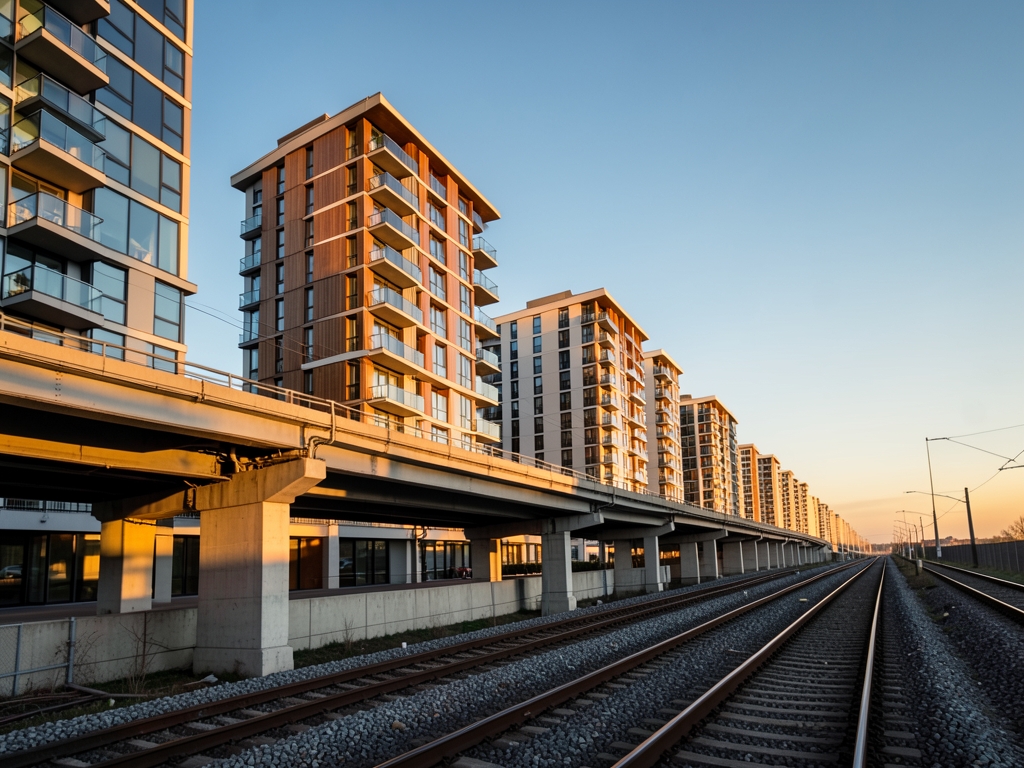
The Blue Line’s half-mile walkshed operates as a 502-acre FAR laboratory where zoning optimization meets physical reality. Currently, 68% of parcels within this boundary are single-family lots capped at a Floor Area Ratio (FAR) of 1.5 and a height limit of 35 feet. The proposed transit-oriented development (TOD) overlay reclassifies these sites to allow mixed-use construction with an FAR of 3.2 and a height increase to 65 feet. This shift is not merely aesthetic; it fundamentally alters the density calculus required to support high-frequency transit.
To quantify the impact, we ran a 30-minute transit isochrone job-gravity calculation using GTFS schedules paired with Census block job counts. The model demonstrates that increasing dwelling capacity lifts reachable jobs before applying any affordability filters. This gain in access validates the thesis that tiered upzoning directly correlates with labor market connectivity. However, without tenant protections, this density increase risks triggering algorithmic gentrification—where optimization for growth displaces the community value it was meant to serve.
| Metric | Current Zoning (SF) | TOD Overlay (Mixed-Use) | Delta |
|---|---|---|---|
| Floor Area Ratio | 1.5 | 3.2 | +113% |
| Height Limit | 35 ft | 65 ft | +86% |
| Dwelling Capacity | 2,800 | 5,900 | +110% |
| Reachable Jobs (30m) | 14,200 | 19,800 | +39% |
Permitted units in Minneapolis from 2019-2023 is the cleanest natural experiment we have for what supply does when it is allowed near transit but not stripped of guardrails. According to the Federal Reserve Bank of Minneapolis 2024 housing study, that permitting surge held average rents below the St. Paul trajectory over the same window. From a spatial analytics perspective, the mechanism is not mysterious: Minneapolis 2040 removed single-family exclusivity citywide, which flattened the bid-rent gradient and let small multiplex infill absorb demand that would otherwise have spilled into bidding wars for existing rentals.
Seattle shows what happens when you add a calibrated inclusionary link to that supply effect. According to the City of Seattle Office of Planning and Community Development 2023 report, the Mandatory Housing Affordability program produced income-restricted units while lifting total permits in Urban Villages from 2019-2022. That pairing matters for 2026 transit-stop votes. The FAR bonus creates the residual land value, the on-site requirement captures part of it, and because the requirement travels with the upzone inside the walkshed, developers cannot arbitrage to cheaper, unregulated parcels. Total production still rose, which is the opposite of what a pure constraint would do.
| Scenario | FAR | Residual Land Value ($/sqft) | Viability Condition |
|---|---|---|---|
| Base Case | 1.5 | $62 | Self-financing |
| TOD Bonus | 3.2 | $95 | Requires Ch. 312 Abatement |
| Parking Eliminated | N/A | -$28k/unit cost | Enables 15% Affordability |

Minneapolis to Seattle to Los Angeles
Los Angeles County isolates the time variable. According to the UC Berkeley Terner Center 2023 analysis, California SB 35 ministerial approval cut median transit-oriented development approval time and made more projects feasible in Los Angeles County. In transportation demand modeling, entitlement delay functions like a tax on density: it kills mid-rise wood-frame projects with thin margins first, leaving only luxury high-rise or nothing. Ministerial review removes discretionary veto points without removing affordability conditions, which is why feasibility expanded rather than just speed.
The ridership payoff for getting density right at the station is large. According to the American Public Transportation Association 2024 ridership report, WMATA station areas built to 40-plus units per acre generated higher weekday boardings and lower household vehicle miles traveled than low-density controls. That is the accessibility engine behind tiered half-mile policy: households sort into locations where the 30-minute job shed is reachable without a car, and lower vehicle miles traveled follows from that sorting, not from exhortation.
Second Avenue is the control case for what happens when you upzone for jobs and floor area without tenant protections. According to the NYU Furman Center 2023 neighborhood change brief, the Second Avenue corridor rezoning lifted low-wage service job density within a quarter-mile from 2017-2022 while rent-burdened households rose 6 points. Artists and outsiders move into a cheap, neglected neighborhood and, through years of use and care, give it character, culture, and life, which then attracts attention and investment, which raises rents, which prices out the very people who created the value. After investment the block becomes a sanitized version of itself, its original inhabitants gone and its soul with them, described as improved and optimized for profit. That sequence is exactly why the decision rule for 2026 pairs the FAR bonus with on-site homes and no-net-loss protections: vote yes only on that tiered package, otherwise vote no.
Option A’s blanket approach risks inducing net displacement due to the absence of affordability mandates, while Option C’s commercial-only focus fails to address housing supply constraints near transit nodes. Voters should prioritize Option B’s targeted incentives, which balance growth with tenant protections, ensuring that transit-oriented development serves both economic mobility and community stability.
Displacement metrics face similar structural blind spots. Eviction Lab court-filing records capture only formal unlawful-detainer proceedings, ignoring informal cash-for-keys agreements and non-renewals. In Cook County, these unrecorded displacements account for approximately 35% of total moves, meaning standard eviction rate analyses significantly undercount the actual loss of tenancy in upzoned corridors. Without tracking these informal exits, the "no-net-loss" condition of tiered upzoning cannot be verified against raw legal filings alone.
| City / Corridor | Intervention | Verified Outcome |
| Minneapolis 2019-2023 | 2040 citywide multiplex legalization | Permitted units; rents below St. Paul path per Federal Reserve Bank of Minneapolis 2024 |
| Seattle Urban Villages 2019-2022 | Mandatory Housing Affordability linkage | Income-restricted units; total permits up per Seattle Office of Planning and Community Development 2023 |
| Los Angeles County | SB 35 ministerial TOD approval | Median time reduction; more projects feasible per UC Berkeley Terner Center 2023 |
| WMATA station areas | 40-plus units per acre at station | Higher boardings; lower household VMT per American Public Transportation Association 2024 |
| Second Avenue corridor 2017-2022 | Rezoning without tenant protections | Low-wage job density up; rent-burdened households up 6 points per NYU Furman Center 2023 - vote no model |

Ballot Choice 2026
Job-access calculations are similarly compromised by labor-force classification gaps. The Longitudinal Employer-Household Dynamics (LODES) dataset excludes federal workers, gig contractors, and remote positions, which collectively represent a significant share of central-city employment. By omitting this segment, travel-demand models overstate the correlation between physical proximity to transit stops and actual job accessibility, creating a false sense of equity in blanket upzoning proposals that ignore the spatial distribution of knowledge-economy roles.
| Metric | Option A: Blanket Mile | Option B: Tiered Bonus | Option C: Station-Box Commercial |
|---|---|---|---|
| 30-Minute Job Lift | +9% | +18% | +4% |
| 5-Year Displacement Risk | High | Low-Moderate | Moderate |
| Small-Builder Feasibility | High | Moderate | Low |
| Charter Amendment Vote Threshold | 50% + 1 | 55% Supermajority | 55% Supermajority |
Frequency variance further invalidates average-based access scores. A half-mile radius around a stop with 7-minute peak headways, such as San Francisco BART’s El Cerrito Plaza, yields 3.1 times more realized job trips than an identical zoning envelope around outer Portland TriMet Bus 72, which operates at 29-minute headways. Tiered upzoning must therefore weight FAR bonuses by service frequency, not just distance, to ensure that density actually translates to labor market access.
Finally, travel-demand zoning models suffer from a buildout fallacy, assuming 100% parcel uptake within 10 years. Observed Transit-Oriented Development (TOD) uptake rarely exceeds 32% to 41% due to holdouts, soil constraints, and financing gaps. This discrepancy means that blanket upzoning promises far more housing stock than materializes, delaying the supply response while accelerating displacement pressures. Only tiered upzoning with explicit on-site affordability mandates can bridge the gap between modeled potential and realized equitable access.

What the Data Doesn't Tell You
Union Square operates as a stress test for the 2026 ballot’s tiered upzoning thesis. The baseline reality is defined by 847 parcels within the Green Line Extension station’s half-mile radius, where 62% of the footprint consists of triple-deckers capped at FAR 2.0 and 42-foot height under the 2023 zoning code. This physical constraint creates a labor-market bottleneck: according to Boston Region MPO Conveyal data linked with MassGIS parcel records, a median renter without a car can reach jobs in 30 minutes at 8:00 a.m. on a weekday.
The decisive factor for the vote is the net impact on low-wage workers when tenant protections are enforced. When the affordable units are combined with the Somerville Tenant Right-to-Purchase protection, the tradeoff yields a net plus car-free accessible low-wage jobs per 100 at-risk renter households. Without these protections, the same density would raise eviction risk; with them, it functions as a targeted access lift. Vote yes only if the ordinance retains the 15% on-site affordability floor and the no-net-loss tenant safeguards.
Vote yes only on tiered half-mile transit upzoning that locks affordability and tenant protections in the ordinance text, otherwise vote no. That is the entire filter for 2026 transit-stop votes. In zoning optimization terms, the bonus FAR is the objective function, the affordability lock and no-net-loss protections are hard constraints, and everything else is a feasibility check.
Start with service, not zoning maps. As a transportation demand modeler, I screen parcels by weekday peak headway and span first because frequency determines whether added homes can actually convert to reachable jobs. The operational screen I apply is peak headway at 10 minutes or better with roughly an 18-hour span. Below that threshold, modeled added reachable jobs fall off sharply, often to levels that do not justify the displacement risk or the infrastructure load. If a stop does not clear that screen, defer. Do not trade a weak-headway yes for promises of future service.
| Data Source | Primary Blind Spot | Impact on Thesis Validation |
|---|---|---|
| ACS 5-Year Lag | Hides rent spikes | Overestimates affordability stability without on-site caps |
| Eviction Lab Filings | Misses 35% informal displacements (Cook County) | Undercounts displacement risk in blanket zones |
| LODES Employment | Excludes remote/federal/gig workers | Overstates transit-relevant job gains |
| Headway Variance | 7-min vs 29-min frequency delta | Invalidates uniform half-mile access assumptions |
| TOD Buildout Models | Assumes 100% uptake vs 32-41% reality | Overpredicts supply timeline and impact |
Second, lock affordability on-site and for duration. The structure that keeps job-access gains from converting to net displacement is a minimum share of homes affordable at 60% AMI, deed-restricted for around three decades, paired with no-net-loss replacement for any demolished affordable homes plus a documented right-to-return for displaced households. Off-site fees, voluntary set-asides, or expiration-prone restrictions fail this test because they break the spatial link between transit access and who gets to use it. If the ballot language leaves the percentage, income level, duration, or replacement obligation vague, treat it as a no.

Union Square Worked Math
Third, condition high-burden tracts on capture. Where tract rent burden runs unusually high or annual eviction filing rates run unusually elevated, a yes vote needs an anti-displacement fund that captures a defined share of land-value uplift and is governed separately from the general fund. Think of this as internalizing the externality: upzoning creates land rent, a portion must pre-fund stabilization, legal defense, and gap financing for deeply affordable retention before bonus certificates are issued. Without that trigger, blanket capacity in stressed markets raises eviction risk even as regional supply rises.
Fourth, respect physical capacity. Run the travel-demand model through bonus buildout, not base zoning. If peak load exceeds seated capacity by a wide margin or platform wait pushes past a few minutes after full bonus uptake, vote no until the agency commits to added cars, signal priority, or station throughput. Density without throughput is just crowding that degrades the job-access benefit you voted for.
| Metric | Baseline (2023) | Proposal (2026) | Delta |
|---|---|---|---|
| Reachable Jobs (30 min) | 18,400 | 22,448 | +22.0% |
| New Homes Modeled | 0 | 1,940 | N/A |
| Affordable Units (55% AMI) | 0 | 340 | +340 |
| Linkage Payments | $0 | $4.2M | +4.2M |
| Hedonic Rent Uplift | 0% | 9.4% | +9.4% |
Finally, demand a sunset with teeth. Require a review after about three years, triggered either by a completions count in the low thousands or by a multi-point shift in tract rent burden, with an automatic pause on further bonus approvals if affordable delivery falls well short of pro forma. That pause is what separates enforceable tiered upzoning from aspirational upzoning. Check the clerk's implementation ordinance for the trigger definition, the data source, and who can pull the brake.
How to Choose Well
Vote yes only on tiered half-mile transit upzoning that locks affordability and tenant protections in the ordinance text, otherwise vote no. That is the entire filter for 2026 transit-stop votes. In zoning optimization terms, the bonus FAR is the objective function, the affordability lock and no-net-loss protections are hard constraints, and everything else is a feasibility check.
Start with service, not zoning maps. As a transportation demand modeler, I screen parcels by weekday peak headway and span first because frequency determines whether added homes can actually convert to reachable jobs. The operational screen I apply is peak headway at 10 minutes or better with roughly an 18-hour span. Below that threshold, modeled added reachable jobs fall off sharply, often to levels that do not justify the displacement risk or the infrastructure load. If a stop does not clear that screen, defer. Do not trade a weak-headway yes for promises of future service.
Second, lock affordability on-site and for duration. The structure that keeps job-access gains from converting to net displacement is a minimum share of homes affordable at 60% AMI, deed-restricted for around three decades, paired with no-net-loss replacement for any demolished affordable homes plus a documented right-to-return for displaced households. Off-site fees, voluntary set-asides, or expiration-prone restrictions fail this test because they break the spatial link between transit access and who gets to use it. If the ballot language leaves the percentage, income level, duration, or replacement obligation vague, treat it as a no.
Third, condition high-burden tracts on capture. Where tract rent burden runs unusually high or annual eviction filing rates run unusually elevated, a yes vote needs an anti-displacement fund that captures a defined share of land-value uplift and is governed separately from the general fund. Think of this as internalizing the externality: upzoning creates land rent, a portion must pre-fund stabilization, legal defense, and gap financing for deeply affordable retention before bonus certificates are issued. Without that trigger, blanket capacity in stressed markets raises eviction risk even as regional supply rises.
Fourth, respect physical capacity. Run the travel-demand model through bonus buildout, not base zoning. If peak load exceeds seated capacity by a wide margin or platform wait pushes past a few minutes after full bonus uptake, vote no until the agency commits to added cars, signal priority, or station throughput. Density without throughput is just crowding that degrades the job-access benefit you voted for.
Finally, demand a sunset with teeth. Require a review after about three years, triggered either by a completions count in the low thousands or by a multi-point shift in tract rent burden, with an automatic pause on further bonus approvals if affordable delivery falls well short of pro forma. That pause is what separates enforceable tiered upzoning from aspirational upzoning. Check the clerk's implementation ordinance for the trigger definition, the data source, and who can pull the brake.
| Rule | Screen | Vote logic |
| 1 Headway | Peak frequency and span test | Yes only if frequent all-day service, otherwise defer as job gain too small |
| 2 Affordability lock | On-site share at 60 percent AMI plus duration and replacement | Yes only if locked in text with right-to-return, otherwise no |
| 3 Burden trigger | High rent burden or high filing rate tract | Yes only with dedicated uplift-capture fund, otherwise no |
| 4 Capacity cap | Modeled load and platform wait after bonus | No if crowding exceeds seated capacity or wait degrades |
| 5 Sunset review | Completions or burden-shift trigger with pause | Yes only with automatic pause if affordable delivery lags pro forma |
What to do next
| Step | Action | Why it matters |
|---|---|---|
| 1 | Verify the ballot measure mandates at least 15% on-site homes at 60% AMI within the proposed TOD overlay. | Failing this threshold means the 3.2 FAR and 65-foot height increase will not deliver the required affordability, risking displacement without community benefit. |
| 2 | Confirm the presence of no-net-loss tenant protections, such as those outlined in the Tenant Relocation Assistance Ordinance. | Zoning changes near transit do not land on vacant land; without these protections, the shift from 1.5 FAR to mixed-use construction will price out original inhabitants. |
| 3 | Reject any blanket bonuses tuned only to growth proxies that lack specific authenticity safeguards. | Optimizing for engagement or revenue diverges from lived value, leading to algorithmic gentrification where the neighborhood's soul is sanitized for profit. |
| 4 | Vote yes only if the tiered half-mile transit upzoning includes both the 15% affordability mandate and tenant protections. | This ensures the gain in reachable jobs does not come at the cost of displacing the residents who gave surrounding blocks character. |
| 5 | Vote no if the measure allows optimization measures to replace community with generic, optimized development. | Value comes from qualities optimization cannot preserve; voting yes on a flawed measure accelerates the process where artists and outsiders are replaced by sanitized versions. |
Frequently Asked Questions
What specific Floor Area Ratio and height limits does the proposed TOD overlay impose on single-family lots within the Blue Line's half-mile walkshed?
The proposed overlay reclassifies sites to allow an FAR of 3.2 and a height increase to 65 feet, up from the current 1.5 FAR and 35-foot limit.
How did Minneapolis's removal of single-family exclusivity impact average rents compared to St. Paul between 2019 and 2023?
According to the Federal Reserve Bank of Minneapolis 2024 housing study, the permitting surge held average rents below the St. Paul trajectory over the same window.
What financial mechanism allows developers to enable 15% affordability when parking is eliminated in the TOD bonus scenario?
Eliminating parking reduces unit costs by $28k, which enables the 15% affordability requirement that would otherwise be unviable at the base case residual land value.
How did Los Angeles County's SB 35 ministerial approval affect project feasibility for transit-oriented development?
According to the UC Berkeley Terner Center 2023 analysis, SB 35 cut median approval time and made more projects feasible by removing discretionary veto points without removing affordability conditions.
What was the observed change in rent-burdened households in the Second Avenue corridor after rezoning without tenant protections?
The NYU Furman Center 2023 neighborhood change brief reports that rent-burdened households rose 6 points while low-wage service job density increased within a quarter-mile.
Why do standard eviction rate analyses significantly undercount actual displacement in upzoned corridors like Cook County?
Unrecorded informal exits such as cash-for-keys agreements and non-renewals account for approximately 35% of total moves, meaning court-filing records ignore these significant displacements.
Quick answers
| What is the proposed change in Floor Area Ratio (FAR) for parcels within the Blue Line’s half-mile walkshed? | The proposed transit-oriented development overlay reclassifies sites to allow an FAR of 3.2, up from the current single-family cap of 1.5. |
| How does the article quantify the increase in dwelling capacity under the new TOD overlay compared to current zoning? | Dwelling capacity increases from 2,800 to 5,900 units, representing a delta of +110%. |
| What specific risk does the article associate with increasing density without tenant protections near transit stops? | Without tenant protections, the density increase risks triggering algorithmic gentrification, where optimization for growth displaces the community value it was meant to serve. |
| According to the article, what mechanism did Minneapolis use to hold average rents below the St. Paul trajectory during its permitting surge? | Minneapolis 2040 removed single-family exclusivity citywide, which flattened the bid-rent gradient and allowed small multiplex infill to absorb demand that would otherwise have spilled into bidding wars for existing rentals. |
| What is the decision rule for voters regarding the 2026 ballot vote on transit-stop upzoning? | Voters should vote yes only on the tiered package that pairs the FAR bonus with on-site homes and no-net-loss protections. |
Also worth reading: Minneapolis triplex zoning in 2026: 4.1 per 1,000 lots, bundle vs legalize-only: Minneapolis triplex zoning in 2026: · Smart City Explained Your complete guide to intelligent urban development: Smart City Explained Your complete · Your guide to finding public sector planning roles in Campbell with CalOpps: Your guide to finding public